Introduction
High power rocketry (HPR) is a hobby where enthusiasts design, build, and test advanced rockets. Due to the high propellant quantities used, certification is required. There are three certification levels:
- L1: Motors up to 640 Newton-seconds (Ns)
- L2: Motors up to 5120 Ns
- L3: Motors exceeding 5120 Ns
L1 Certification
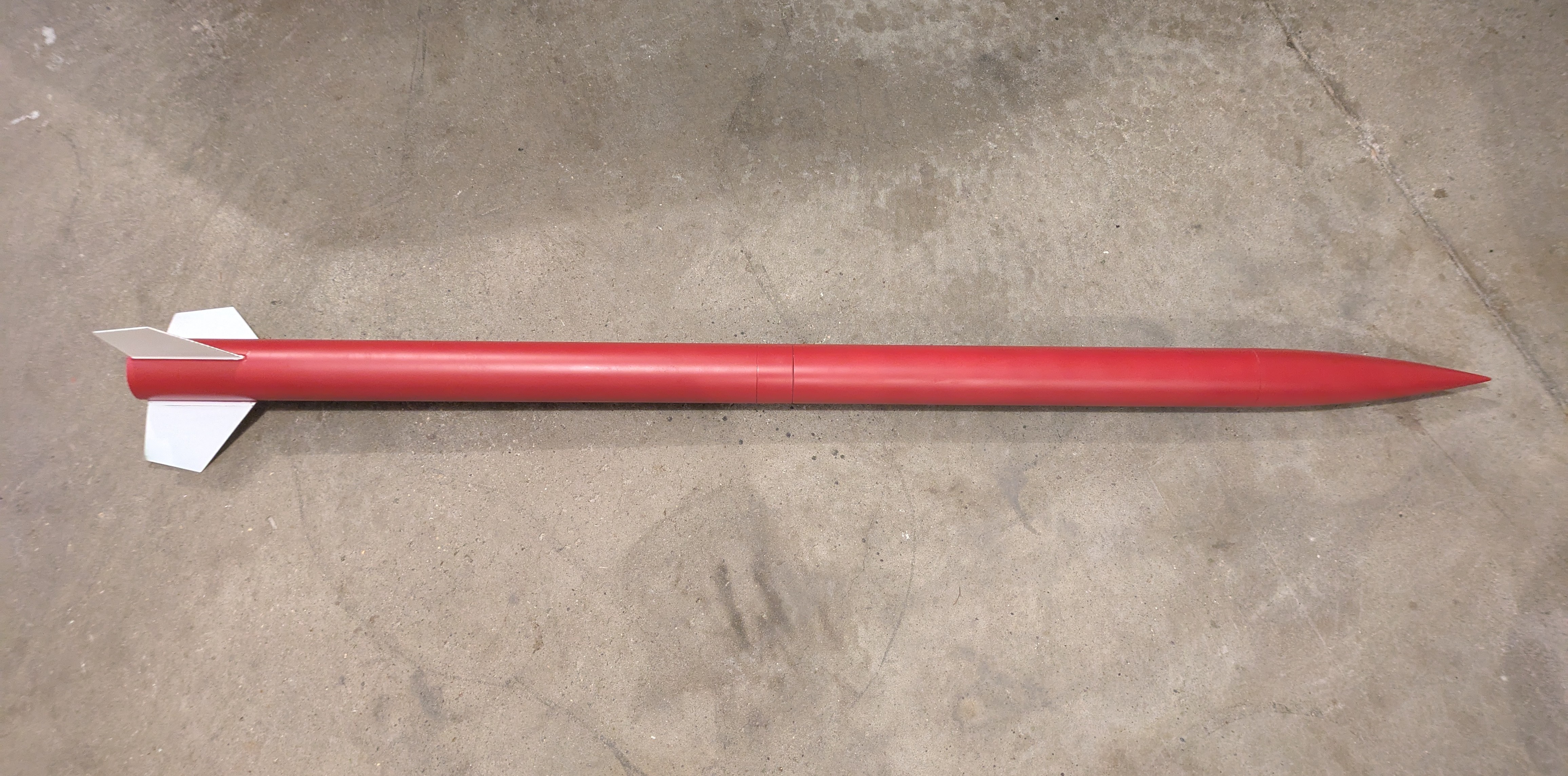
For my L1, I built a Wildman Journey 75, a fiberglass rocket known for its simplicity, durability, and included Rocksim design file for easier simulation. I successfully flew the rocket and earned my L1 certification on the first attempt.
L2 Certification
Airframe
For my L2, I modified the Journey 75 I used for my L1 to save money. Since this rocket would use a larger motor, I needed to add an avionics bay for dual deployment recovery. The increased weight from the avionics and larger motor shifted the center of mass. Using OpenRocket, I determined that adding a 2-foot section would maintain proper stability. I modified the Rocksim file and assembled the airframe before starting work on the avionics bay.
Avionics
I needed two independent deployment methods to ensure redundancy. I chose the Missile Works RRC3 for its affordability and proven reliability. Initially, I planned to use a custom-built flight computer for the second deployment method. However, since it remains untested, I decided to fly it as a payload instead. This allows me to collect flight data, helping validate its performance before integrating it into future recovery systems. The rocket is nearly complete, and I expect to launch within the next couple of months, weather permitting.
Why Build a Custom Flight Computer
I chose to design my own flight computer both to enhance functionality and to gain hands-on experience. Typical COTS avionics rely solely on a barometric pressure sensor. My design integrates a barometric pressure sensor, GPS, and accelerometer with a Kalman Filter for sensor fusion. My avionics system records raw flight data, enabling post-flight analysis to refine future designs. This project provides hands-on experience in PCB design and C++ programming, skills valuable for both industry and future personal projects.